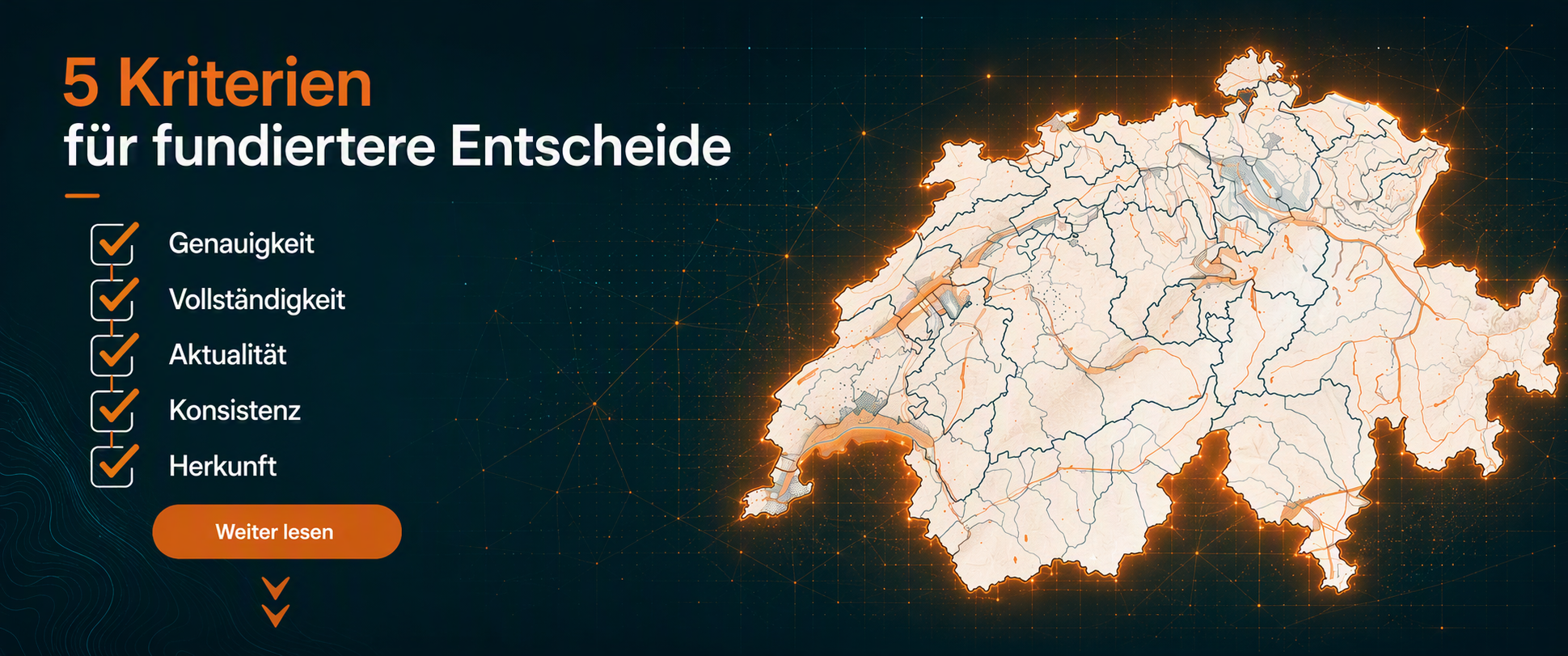
In Switzerland's complex, multi-cantonal real estate market, data quality isn't just a technical requirement, it's a strategic differentiator. Real estate developers, investors and asset managers who can trust their data make faster decisions, identify opportunities earlier, and avoid costly errors. Mistakes that plague competitors still working with fragmented data such as outdated spreadsheets, irregular municipal updates and other data sources that were never meant to work together.
"Business owners using advanced PropTech analytics report average improvements of 34% in investment decision accuracy and 41% faster deal closure times. Real estate firms implementing comprehensive data analytics platforms achieve average NOI improvements of 8-12% within 24 months through better-informed asset management decisions."
Wiss & Company, "PropTech and Its Impact on the Real Estate Market" (2024/2025) [1]
A single wrong assumption about zoning regulations, vacancy rates (Leerstand), or local purchasing power (Kaufkraft) can have a huge impact on the return of investment on a property. The challenge isn't finding data—it's finding reliable, timely, and actionable data. With 26 cantons, over 2,100 municipalities, constantly evolving regulations and increasingly more data sources and information to check, Swiss real estate professionals face a unique complexity: what works in Zürich doesn't apply in Luzern, and yesterday's zoning data might be obsolete today.
This matters because data quality isn't just a technical concern, it provides a competitive advantage: The one who can quickly identify underperforming properties, spot regulatory changes early, and benchmark portfolio performance against market realities consistently outperform those who can't. The question is: how do you ensure the data driving your decisions is actually trustworthy?
Not all Immobiliendaten are created equal. Before we examine sources, let's establish what "quality" actually means in the context of real estate asset management.
Data must reflect reality. A property database showing incorrect parcel sizes, outdated ownership information, or wrong zoning classifications creates more problems than it solves - especially when you are a real estate developer or broker. In Switzerland, where building regulations vary dramatically by municipality, even small errors compound quickly.
Partial data leads to partial decisions. For example if your dataset covers vacancy rates but not demographic trends or demand driving criteria such as proximity to facilities like daycare, schools, restaurants, and public transport, and the average income in the region. Or includes data from canton Zürich but excludes specific rules from the 160 smaller communes within the canton, you're operating with blind spots. For investment decisions, completeness across all relevant attributes and geographies is non-negotiable.
Real estate moves slowly until it doesn't. Zoning revisions, infrastructure projects, and market shifts can fundamentally alter property values within months. Data updated quarterly—or worse, annually—leaves you reacting to changes your competitors saw coming.
When data from different sources uses different definitions, formats, or measurement standards, analysis becomes guesswork. Swiss real estate data is particularly vulnerable to this: each canton may define "residential zone" differently, making cross-regional comparisons treacherous without proper normalization.
Can you trace data back to its authoritative source? For regulatory information, this might be cantonal geodata services. For market data, it could be the Federal Statistical Office (BFS). Unknown or unclear provenance should trigger skepticism—especially for commercial data providers who don't disclose their methodology.
Switzerland's federal structure creates data challenges that don't exist in more centralized markets. Consider:
This fragmentation means that assembling a complete, accurate picture of the Swiss real estate market requires integrating dozens of disparate sources,each with its own quirks, update schedules, and quality standards.
Understanding where data comes from helps you evaluate its reliability and appropriate use cases.
The BFS provides foundational demographic and economic data, including population statistics, employment figures, and housing stock information. This data is highly authoritative and free, but it's typically aggregated at municipal or cantonal level and updated annually—too slow for tactical decisions.
Best for: Long-term trend analysis, demographic context, market sizing
Limitations: Low granularity, low frequency updates, no property-level detail
Each canton and local commune maintains its own geoinformation system with parcel boundaries, zoning plans, and building footprints. Quality and accessibility vary dramatically: Zürich and Zug offer excellent digital access, while some smaller cantons still rely heavily on PDF documents. Some update very frequently, while others do so sporadically.
Best for: Regulatory compliance, development potential analysis, site selection
Limitations: Inconsistent formats, varying update frequencies, requires technical expertise to process
This official registry contains basic information on every building in Switzerland, including construction year, number of units, and heating systems. It's comprehensive but intentionally limited in scope.
Best for: Building inventory, energy analysis, renovation planning
Limitations: No market values, limited attribute depth, self-reported data quality issues
Many asset managers subscribe to commercial SaaS platforms for market intelligence, property valuations, and transaction data. These services aggregate information from multiple sources and add proprietary analytics.
Strengths: User-friendly interfaces, regular updates, cross-market comparability
Limitations: "One-size-fits-all" approach, limited customization, data quality varies by provider, everyone has access to the same and often not all information (no competitive advantage)
The critical question: are you paying for convenience or for unique insights? If competitors use the same platform, you're all working from the same playbook.
Some larger asset managers invest in building their own data infrastructure, either through internal teams or specialized data partners who provide tailored solutions.
Strengths: Customized to specific needs, potential for unique competitive advantage, control over update frequency
Limitations: Resource-intensive, requires technical expertise, high, ongoing maintenance burden
When assessing any real estate data source, whether you're considering a new provider or auditing existing systems, use this systematic approach:
For Swiss real estate, consider that municipal zoning changes, building permits, and infrastructure projects can materially impact property values within weeks—not months.
Select a sample of properties you know well and verify data accuracy. Check:
If sample accuracy is below 95%, treat the entire dataset with caution.
When evaluating real-estate investments or development potential, it is often underestimated how much bad data can impact returns due to direct errors, but in lost opportunities and wasted time.
Analyst Time: If your team spends 60-70% of their time gathering and cleaning data rather than analyzing it, you're essentially paying professional salaries for manual data entry. For a three-person team, this could represent CHF200,000+ in annual opportunity cost.
Missed Opportunities: Learning about attractive properties from LinkedIn posts after competitors have secured them isn't just frustrating,it's expensive. Each missed acquisition represents potential returns that went to someone else.
Bad Decisions: Inaccurate vacancy rate data (Leerstand) might lead you to overestimate rental income. Wrong zoning information could mean investing in a property with no development potential. These aren't hypothetical risks, they happen regularly when data quality is poor.
Strategic Costs
Beyond direct financial impact, poor data quality creates strategic disadvantages:
“According to a 2025 global survey of over 165 real estate investment professionals by Vistra Fund Solutions and Funds Europe, nearly two-thirds of real estate managers admitted that poor data quality has already restricted their ability to raise capital or forced them to abandon strategies altogether."
Vistra Fund Solutions & Funds Global Intelligence, "Data at the Crossroads: How quality, governance and AI are reshaping real estate investment management" (October 2025)[2]
The path forward doesn't require abandoning existing systems or making massive technology investments. It starts with understanding what quality means in your specific context, auditing your current state honestly, and systematically addressing the gaps that matter most for your portfolio.
Start with these practical steps:
Document every data source you currently use:
This audit often reveals surprising redundancies and gaps.
Not all data needs to be perfect. Focus quality improvements on:
Define specific, measurable standards:
What gets measured gets managed.
Implement systematic checks:
For many professionals in real estate, the optimal solution isn't building everything in-house or accepting generic SaaS limitations, it's partnering with specialists who can provide tailored, high-quality data feeds that meet your business needs. The key is finding a partner who treats data quality as their core mission, not a secondary feature of their software. A partner that can work with your existing workflows and tailor a solution that fits to your business case, without disrupting existing operations, and give you that competitive edge that you are looking for.
Ready to see how high-quality, Switzerland-specific real estate data can transform your portfolio analysis?
Explore our example data sets covering parcel-level development potential, normalized zoning information, and continuous municipal monitoring across all Swiss cantons.
[1] Wiss & Company, "PropTech and Its Impact on the Real Estate Market" (2024/2025). Available at: https://wiss.com/proptech-and-its-impact-on-the-real-estate-market/https://wiss.com/proptech-and-its-impact-on-the-real-estate-market/
URL: [2] Vistra Fund Solutions & Funds Global Intelligence, "Data at the Crossroads: How quality, governance and AI are reshaping real estate investment management" (October 2025) https://www.vistra.com/insights/data-quality-direct-predictor-fundraising-success-and-firms-competitive-viability
Q: How often should real estate data be updated for effective portfolio management?
A: It depends on the data type. Market prices and transaction data can be updated monthly or quarterly, but regulatory information (zoning changes, building permits, Mitwirkungsverfahren) should be monitored continuously. For Swiss asset managers, monthly updates represent a practical minimum for most operational data, with weekly monitoring for regulatory changes that could impact property values.
Q: What's the difference between data accuracy and data precision in real estate?
A: Accuracy means data reflects reality (a property's actual size is 1,200 m², and your data says 1,200 m²). Precision refers to the level of detail (1,200 m² vs. 1,203.7 m²). For most asset management decisions, accuracy matters more than precision—it's better to have a reliably correct approximate value than a precisely wrong number.
Q: How can I verify data quality without hiring a dedicated data team?
A: Start with spot-checking: select 10-20 properties you know well and compare your data against official sources (cadastral records, municipal websites, physical inspection). Calculate the error rate. If accuracy is below 95%, investigate further. Also, cross-reference data from multiple providers—consistent discrepancies indicate systemic quality issues.
Q: Are free government data sources sufficient for professional real estate asset management?
A: Free sources provide essential foundational data, but they typically lack the timeliness, integration, and analytical depth needed for competitive portfolio management. Most successful asset managers combine authoritative free sources with specialized commercial data that's been processed, normalized, and updated more frequently.
Q: What should I ask a data provider before subscribing to their service?
A: Key questions include: (1) What are your primary data sources and how do you verify them? (2) How frequently do you update different data categories? (3) What's your coverage across Swiss cantons and municipalities? (4) Can you provide a sample dataset for validation? (5) How do you handle cantonal variations and normalization? (6) What's your process when errors are discovered?
Table of Content